Parties Comment on Staff Proposal Implementing Affordability Metrics
In response to the ALJ Ruling inviting party comments, CalCCA recommends various modifications to the methodologies used to assess the impact of Commission actions on affordability. SDG&E requests that the use of the proposed affordability metric be more carefully considered and tested to determine whether it can be practically applied or useful.
The essential usage for medical baseline customers should be incorporated into the Affordability Ratio Calculator tool.
The California Public Utilities Commission (Commission) should not use the affordability metrics as the only method with which to designate vulnerable communities.
An affordability analysis should be required not only in proceedings involving revenue requirement increases (such as rate-setting proceedings), but should also be performed any time the Commission proposes to order procurement or modify rules that could increase compliance costs.
The Staff Proposal’s recommendation to allow the Commission to share, prior to its public release, a proposed decision (PD) with investor-owned utility (IOU) staff in order to obtain affordability analysis from such staff is inappropriate, creates a conflict of interest, and should be removed.
The Commission should require the affordability metrics to be updated through rulings before a PD is issued to obtain the greatest benefit and potential modifications as a result of the affordability analysis.
The Commission should include a cover page in Voting Meeting agendas with a table summarizing the impact each individual agenda item has on each of the three affordability metrics to ensure public availability of and accessibility to the cost implications of Commission actions.
It is unknown whether the Affordability Ratio Calculator tool would be useful, as use of the tool would appear to be inconsistent with law and Commission precedent, and the integrity of its results has not been vetted.
The Commission’s statutory mandate is to determine that “[a]ll charges demanded or received by any public utility …[are] just and reasonable,”22 and the Commission has long held that a “utility is entitled to all of its reasonable costs and expenses.”23 SDG&E and SoCalGas are unaware of any legal authority that would require just, reasonable, and necessary utility expenditures to be capped at a CPI-based rate of increase. Any adopted affordability metrics must be reconciled with the applicable law and the Rate Case Plan Decision in order to be useful for decision-making purposes in future GRCs and other revenue requirement proceedings.
The Affordability Ratio Calculator tool must also be vetted to demonstrate the integrity and usefulness of its results.
It is Premature to use the Affordability Metrics to Identify/Designate Vulnerable Communities.
SDG&E and SoCalGas recommend the Commission clarify its intent on how the affordability metrics will be used in the decision-making process. The Staff Proposal lacks explanation on how the metrics will be analyzed, and how the results of the affordability analysis will be considered in rate-setting proceedings. The Staff Proposal fails to state what the criteria is for decision making based on these metrics.
SDG&E and SoCalGas recommend the Commission establish a process for which the affordability metrics and analysis tools can be tested in a pilot or limited implementation. Results from the Pilot Should be Reviewed Before Implementing Affordability Analysis in Other Use Cases
SDG&E and SoCalGas requests that another metric be added which sheds light on the essential utility bill as percentage of median income. The Energy Burden metric captures all customers in a utility’s territory and is simple and easily understood and should be added to the list of metrics so the evaluation is useful for all customers and not only the low-income customers.
COMMISSION ISSUED QUESTIONS
In their written comments, parties may additionally address the following questions.
What outputs from the Affordability Ratio Calculator tool would be useful?
Are there additional ways the metrics can be used to identify/designate vulnerable communities?
Are the specific components of the affordability analysis recommended in section 4a of the staff proposal3appropriate? Why or why not?
Are there additional components that should be added, or components that should be removed?
How and when should updates to the metrics be produced during (e.g., Motion to Adopt Settlement Agreement) and at the conclusion of the proceeding (e.g., Proposed Decision)?
What other affordability analysis use cases, if any, are appropriate?
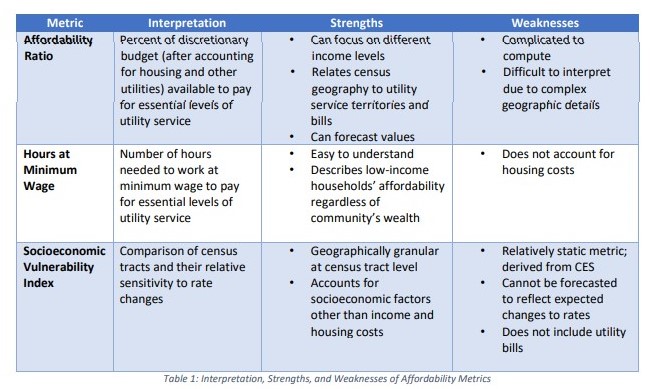
Phase I Decision ("D.") 20-07-032 (the "Decision") established the metrics that will be used for measuring affordability, as well as the data sources and methodologies for doing so. The Decision adopted three metrics, affordability ratio ("AR"), hours at minimum wage ("HM"), and socioeconomic vulnerability, and supporting methodologies to be considered by the CPUC when assessing the affordability of essential electricity, gas, water, and communications utility services.
The Affordability Metrics Implementation Staff Proposal builds on the foundation laid in D. 20-07-032 by establishing how these metrics can be used to provide forward-looking analyses, the process by which the metrics will be refreshed on an annual basis, and how the metrics can be used in various capacities by the CPUC. This staff proposal introduces a specialized, Excel-based tool, the Affordability Ratio Calculator ("ARC"), for use by essential service providers and other parties in calculating the Affordability Ratio ("AR").
Vulnerable Communities Defined Based on Affordability Ratio and Socioeconomic Vulnerability Index ("SEVI") metrics:
In an effort to provide context to the values of the affordability metrics, staff also introduces two new definitions of vulnerable communities based on the AR and SEVI metrics.
Areas of Affordability Concern ("AAC") refers to geographic areas where the AR metric for representative low-income households is disproportionately higher than it is for the rest of the state, based on the distribution of AR values for a given industry. This identifies communities where representative low-income households’ ability to pay for essential services is severely lacking as compared to the rest of the state.
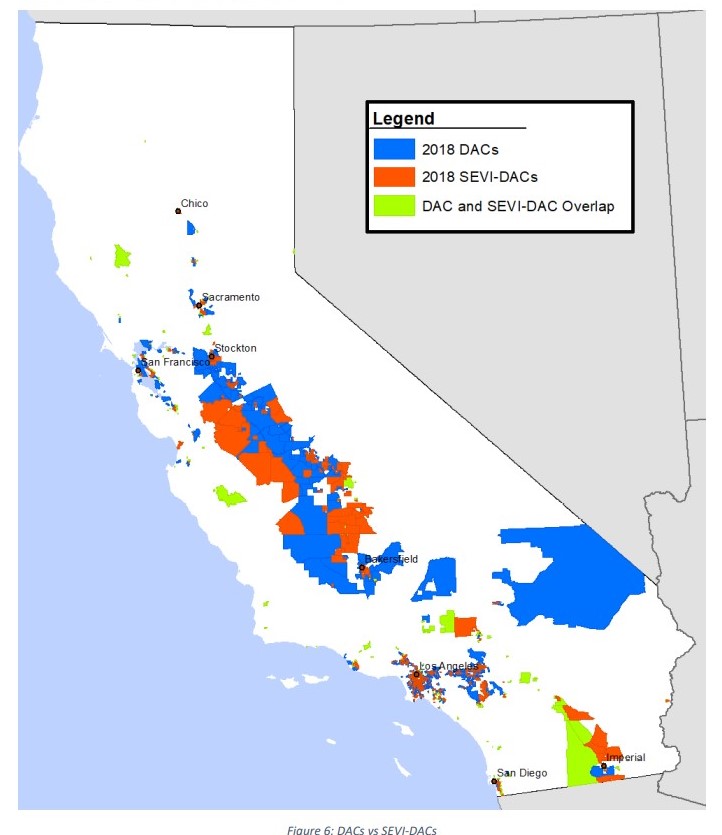
The second concept is a variation of disadvantaged communities ("DAC"), and is known as the SEVI-DAC. While the traditional definition of a DAC is a census tract with a CalEnviroScreen score in the top 25 percent, a SEVI-DAC is a census tract that has a SEVI score in the top 25 percent. By using SEVI rather than CalEnviroScreen, this alternative definition of DACs focuses specifically on the socioeconomic factors that make a community vulnerable rather than incorporating additional considerations, such as pollutants.
Both of these concepts complement existing definitions of vulnerable communities and give policymakers the tools to focus exclusively on the socioeconomic conditions that burden them. By excluding non-socioeconomic factors in the identification of SEVI-DACs, this designation ensures that the most economically vulnerable communities are highlighted and are not obscured when other factors, such as environmental and demographic considerations, are included.
Staff will make publicly available an ARC tool that will allow for calculation of the AR metric by anyone who wishes to understand the affordability impacts associated with a hypothetical essential usage bill amount in future years.
While SEVI is a metric that is derived from CalEnviroScreen and is not capable of being forecasted, HM can be predicted for future years. However, CPUC staff does not plan on issuing a tool for the calculation of future HM values at this juncture.
Affordability Ratio Forecasting Methodology: Income, Housing Costs, and Future Essential Usage Bills
The goal of this forecasting framework is to provide a geographically granular estimate of how socioeconomic conditions will change in California, which will allow for estimation of affordability impacts when combined with assumed future values of essential usage bills.
These models produce regional estimates of inflation for baskets of goods as well as inflation for individual categories of goods and services. Inflation for a basket of goods is generally measured by a consumer price index ("CPI").
Income:
CPI is a widely accepted measure of changes in consumer prices for a “market basket” of goods and services, and is often used in cost-of-living wage adjustments. This metric is a widely used proxy for income growth for the general public because it reflects the nominal change in income required to maintain the same standard of living.
The forecasting methodology for the affordability metrics will make use of two different measures of consumer price indexes ("CPIs") to predict regional changes in household incomes: CPI for all urban consumers, or CPI-U, and CPI for urban wage earners and clerical workers, or CPI-W.
CPI-U will be used to estimate income growth for households at the 50th percentile of the income distribution of each public use microdata area (PUMA) in this forecasting methodology. This will be accomplished by taking the most recent estimate of household income at the 50th percentile of the income distribution for each PUMA (based on the most recently available data from the Census Bureau’s American Community Survey Public Use Microdata 5-Year Sample, as detailed in D.20-07-032) and escalating it based on the CPI-U estimates provided by the Department of Finance for each metropolitan statistical area (MSA). An MSA is a collection of counties that consist of an urbanized area and the surrounding counties and are determined by the Office of Management and Budget (OMB).
While CPI-U is meant to represent the growth in consumer prices for the vast majority of Americans, CPI-W measures consumer price changes for households “in which more than one-half of the household's income comes from clerical or wage occupations.” Since this metric is meant to track the growth in consumer prices for lower-income households as compared to CPI-U, the forecasting methodology will use CPI-W to estimate changes in income for households at the 20th percentile of the income distribution.
Housing Costs:
This metric measures the general change in price for rent for renters and “owners’ equivalent of rent” for homeowners, with the two combined into a single shelter metric that is a weighted average.
The Department of Finance forecast data includes a breakout of the CPI market basket components for each MSA, including the shelter component.
The forecasting methodology for AR will use this value as a measure of the change in housing costs for the forecast period.
Future Values of Essential Usage Bills for Other Industries:
In order to forecast future values of the AR metric, it is necessary to have an estimate of future essential usage bills for all of the services considered. The specific values for future years’ essential usage bills depend on the scenario being considered. In order to understand the affordability impact associated with a future rate change, the AR metric would need to be calculated for the specific set of essential usage bills that a stakeholder is considering.
Affordability Ratio Calculator ("ARC")
Rather than simply define the metric and rely on essential service providers and other parties to calculate AR, staff propose issuing an annually updated Excel-based calculator that will be pre-populated with all of the values needed to calculate AR for representative households at the 20th and 50th percentiles of the income distribution within each PUMA based on the most recently available socioeconomic, essential usage bills, and forecast data.
The Affordability Ratio Calculator will be updated each year and used to prepare the Annual Affordability Report, with the results for the base analysis year being the focus of the report. The specific timing of the updated calculator and Annual Affordability Report will depend on the availability of the underlying datasets used to calculate the inputs.
This tool will be made available to the public through the CPUC website.
HM Forecasting Methodology
The only two inputs are the essential usage bills and the minimum wage for a given locality.
Where forecasted HM values are required in applications, essential service providers will be expected to estimate future values for essential usage bills and identify the most likely future values of local minimum wage.
SEVI Forecasting Methodology
Rather than attempt to forecast future values of SEVI, it is assumed that SEVI will only be used based on the most recently available data for CalEnviroScreen.
Interpretation of Results
Interpretation analysis of affordability metrics calculated as part of proceedings will be incumbent on the energy IOUs, Class-A water utilities, communications service providers, as well as all other stakeholders, including those who choose to perform this analysis as intervenors in a revenue request or program proposal proceeding.
Staff believes that the electric and gas IOUs, the Class-A water utilities, and communications service providers are in the best position to introduce to the proceeding record the affordability metrics in a manner that best balances affordability with other important goals in a proceeding.
Affordability Demarcations using AR20
Affordability concerns particularly stem from the low 20th percentile incomes. It is useful to identify specific AR20 values (demarcations) to aid in interpretation of the affordability metrics results and provide guidance on how to recognize where affordability problems are most severe. Staff identify these demarcations as the point of inflection in each industry’s AR20 distribution of values across the state, based on the observed data in the 2019 Annual Affordability report.
These demarcations should serve as guidance in determining the affordability of essential utility service charges at this time. For a given industry, AR20 values above the demarcation points can indicate enhanced difficulties in making ends meet.
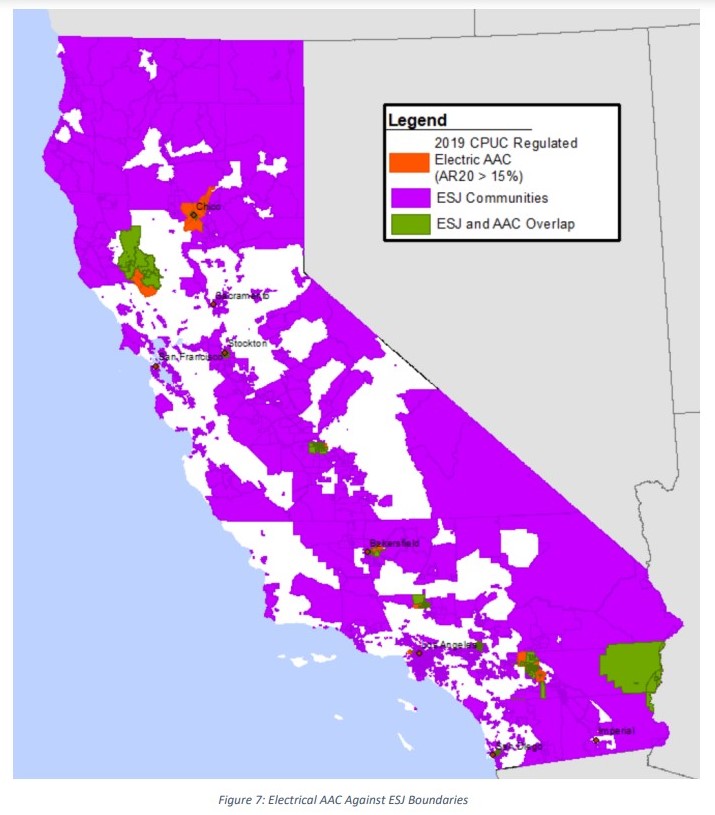
To further apply the affordability demarcations, staff introduce the concept of Areas of Affordability Concern (AAC). In this proposal, we define AACs for each industry as the geographical areas with AR20 scores greater than the affordability demarcations.
SEVI-DACs
While the CalEnviroScreen metric considers the full suite of factors that make a community disadvantaged (including environmental and health indicators in addition to socioeconomic indicators), the SEVI metric is specifically focused on the socioeconomic elements that contribute to a community’s marginalization.
The difference between the two sets of DACs is that, because SEVI does not consider factors such as pollution levels, they highlight slightly different communities, as can be seen below.
Environmental and Social Justice ("ESJ") Communities
To further the goals of the CPUC, decision-makers can apply this affordability framework to environmental and social justice efforts. This affordability framework, with its ability to identify AACs and SEVI-DACs, provides a tangible, geographically-based set of definitions to further the goals of the ESJ Action Plan.
This affordability framework, with its ability to identify AACs and SEVI-DACs, provides a tangible, geographically-based set of definitions to further the goals of the ESJ Action Plan.
The map below, shows the relationship between the AACs for the energy industry and the communities identified as “ESJ communities” in the ESJ Action Plan.
Implementation Strategy - Energy
Use Case #1:Use of Affordability Metrics to Inform Decisions on Revenue Requirement Proposals
For all GRCs and when the revenue requirement request in a non-GRC ratesetting application is subject to the rate classification disclosure of Rule 3.2(a)(3) of the CPUC’s Rules of Practice and Procedure i.e., the proposed revenue requirement increase is greater than one percent, staff recommends that affordability metrics data be included in the application request and testimony.
Use Case #2: Use of Affordability Metrics to Inform Decisions on Program Design and Targeting
In combination with customer-level low-income qualified status (as indicated by CARE eligibility), community-scale AR20 and SEVI offer an opportunity to further refine low-income target areas to highly energy-burdened areas such as those indicated by high AR20 values and high socioeconomic vulnerability areas such as those indicated by high SEVI values.
By specifying customer segments that the IOUs should evaluate as part of complying with OP 58 of the Decision 21-06-015 ("ESA Decision") requiring the IOUs to “detail what level of treatment will be provided to which customer segments,” the CPUC signaled a desire to define more inclusive measures of defining low-income customers in considering different levels of program fund allocations.
The ESA Decision model may serve as a model for other programs such as Transportation Electrification or Building Decarbonization when considering different levels of program fund allocations or benefits for low-income customers.
Use Case #3: Use of Affordability Metrics to Evaluate Options to Mitigate Electric Rate Growth
Staff will also evaluate how the metrics can be used to assess the effectiveness of proposals to make electric rates more affordable, such as those discussed at the En Banc hearing held on February 24, 2021 and subsequently summarized in the 2021 Senate Bill ("SB") 695 (Kehoe, 2009) Report.
Proposals included options to offset volumetric rates with fixed charges, use income-based fixed charges to address potential equity issues associated with residential fixed charges, fund programs with societal benefits through taxpayer funds rather than ratepayer funds, and other options for mitigating rising volumetric electric rates.